
The ingredients in tanning gummies can change the way skin looks, but they don’t provide sun protection. Labels may list beta-carotene, copper, lutein or astaxanthin, while canthaxanthin is not approved or safe to take as a tanning pill. Beta-carotene may give skin a yellow-orange hue, not protection from UV rays.
Ingredient names alone don’t tell you how much of each active ingredient a serving contains, especially when a product uses a proprietary blend. This guide explains how to read tanning gummies ingredients on the label, what beta-carotene may do, and why serving directions and health considerations matter. It also covers how to compare amounts, why taking more than directed isn’t a shortcut, and when to discuss astaxanthin with a GP if you take medication or manage a health condition.
Key Takeaways
- Compare serving directions with the supplements you already take to avoid stacking active ingredients.
- Carotenoid pigments can affect skin tone gradually, and the change may be subtle.
- Look closely for canthaxanthin and understand its potential risks, including effects on vision.
- Separate the role of a supplement from sun protection; a change in skin colour does not block UV rays.
How do you choose tanning food supplements?
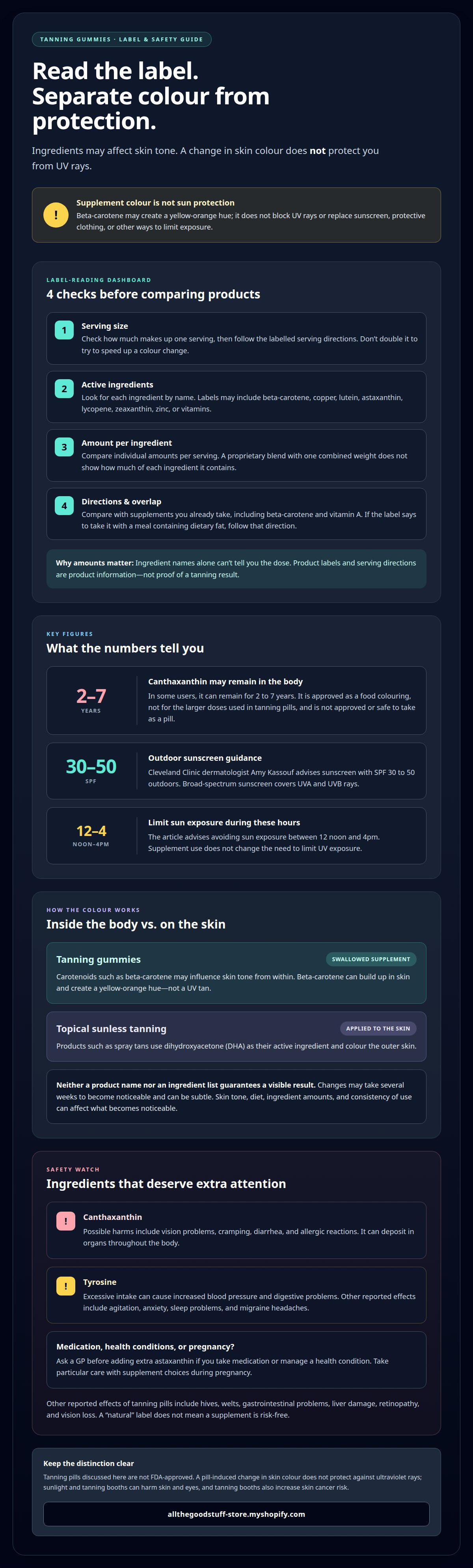
Start with the full label, not the tanning claim on the front. Check the serving size, active ingredients, amount per serving, and directions. A proprietary blend that lists one combined weight for several ingredients doesn’t reveal the amount of each one. That makes it harder to compare amounts or spot overlap with another supplement. For example, compare the beta-carotene in a tanning product with the amount in any multivitamin you already take.
Follow the serving directions. Don’t double the labelled serving to try to speed up a colour change. If the label says to take it with a meal containing dietary fat, follow that instruction. Taking more can increase exposure to active ingredients without making results appear sooner. Whether a visible change occurs, and how pronounced it is, can depend on consistency, skin tone, and diet.
- Check overlap: Add up ingredients that appear in multiple supplements, including beta-carotene and vitamin A.
- Review the blend: Look for amounts beside individual ingredients, not only a combined blend weight.
- Follow the serving: Use the labelled amount and any meal directions.
Keep supplement labelling in context. The tanning pills discussed here are not FDA-approved. Treat the ingredient panel and serving directions as product information, not proof of a tanning result. Beta-carotene and copper are identified as ingredients that promote melanin production, but a label cannot guarantee a change in skin colour. If you take medication or manage a health condition, ask a GP before adding extra astaxanthin.
Gummies and topical sunless tanning products work differently. Topical products, including spray tans, use dihydroxyacetone (DHA) as their active ingredient. Gummies are swallowed supplements containing ingredients such as carotenoids. A topical product colours the outer skin, while supplement ingredients may influence skin tone from within.
Does beta carotene help with tanning too?
Beta-carotene can affect skin tone, but it does not provide UV protection. Its effect differs from the surface colour produced by topical sunless tanning products.
Beta-Carotene and Carotenoid Pigments
Beta-carotene is an orange-gold carotenoid pigment found in carrots and sweet potato. Other carotenoids, including lycopene, lutein, and zeaxanthin, also appear in some tanning supplements. These ingredients aren’t interchangeable: each has its own role and listed amount. Check the label for individual quantities rather than assuming a blend provides a particular amount of beta-carotene or another pigment.
Beta-Carotene and Skin Color
The body converts beta-carotene into vitamin A. When enough beta-carotene builds up in the skin, it can create a yellow-orange hue. That colour is different from a UV tan, so a change in appearance doesn’t mean the skin is better protected from sunlight. High lycopene intake can also turn skin orangey, making the type and quantity of carotenoids relevant when comparing formulas.
Beta-carotene and copper are identified as ingredients that promote melanin production, but that doesn’t mean every formula containing them produces the same visible result. The listed amounts, consistency of use, skin tone, and diet can all affect what becomes noticeable. Compare ingredient panels rather than relying on package words such as “glow” or “tan”.
Tanning gummy results may take several weeks to become noticeable, and some people see only a subtle change. Beta-carotene may shift skin tone through pigment, but it doesn’t guarantee a bronzed appearance. The ingredient list explains what a product contains, not what an individual result will be. Keep this distinction in mind when setting expectations before choosing a supplement.
For a closer look at product information, review tanning gummy details alongside its ingredient panel and serving directions.
Is It Safe To Use Tanning Pills?
Pregnancy makes supplement choices especially important, so don’t assume a tanning pill is suitable. If you take medication, ask a GP before adding extra astaxanthin.
Canthaxanthin Safety Risks
Canthaxanthin is a tanning-pill ingredient that is approved as a food coloring, not for the larger doses used in pills. It is not approved or safe to take as a pill. It can deposit in organs throughout the body, and possible harms include vision problems, cramping, diarrhea, and allergic reactions. In some users, it can remain in the body for 2 to 7 years.
Tyrosine-Related Risks
Check the amount of tyrosine, too, as excessive intake can cause increased blood pressure and digestive problems. Other reported effects include agitation, anxiety, sleep problems, and migraine headaches. A “natural” label doesn’t mean a supplement is risk-free. Both the active ingredients and serving directions matter, particularly when combining products.
Other reported effects of tanning pills include hives, welts, gastrointestinal problems, liver damage, retinopathy, and vision loss. Taking too much of an active ingredient may also stress the liver. Check the ingredient panel and serving directions, and don’t double a serving to try for faster colour. If you take medication, discuss extra astaxanthin with a GP.
A pill-induced change in skin colour does not protect against ultraviolet rays. Sunlight and tanning booths can harm skin and eyes; tanning booths also increase skin cancer risk. Keep sun protection separate from supplement use. Cleveland Clinic dermatologist Amy Kassouf advises using sunscreen with SPF 30 to 50 outdoors. Broad-spectrum sunscreen covers UVA and UVB rays, and sun exposure should be avoided between 12 noon and 4pm.
Take particular care with supplement ingredients and serving amounts during pregnancy or when using medication. Tanning pills don’t replace sunscreen, protective clothing, or other steps to limit UV exposure.
Tanning pill ingredients
Ingredient panels vary, so compare active ingredients and amounts per serving instead of relying on the product name. Common entries include beta-carotene, copper, lutein, and astaxanthin. Some formulas also list lycopene, zeaxanthin, zinc, or vitamins. To compare tanning gummies ingredients, start with the amount beside each one: its presence alone doesn’t tell you the dose.
Examples from product labels show why serving details matter. One two-gummy serving lists 25 mg of beta-carotene. Another serving lists 7,500 mcg of beta-carotene, 50 mg of lycopene, 30 mg of zinc citrate, 125 mcg of vitamin D3, 50 mg of vitamin B3, and 100 mg of vitamin C. These amounts belong to different label examples, not a single formula. Compare each ingredient and its serving unit separately.
Astaxanthin is an antioxidant, but there’s no single amount that guarantees a visible change in skin tone. A blend that combines several ingredients under one total weight also hides each ingredient’s individual amount. Compare tanning gummies ingredients by checking for the quantity beside every active ingredient. Include sugar and serving size in the review; one label example lists 1.5 g of sugar per pack.
A brand name doesn’t establish which ingredients a product contains. Formulas and serving sizes differ, so use the current package label to identify the exact combination and quantities. Focus on these details:
- Pigments: beta-carotene, lycopene, lutein, and zeaxanthin.
- Other listed ingredients: copper, astaxanthin, zinc, and vitamins.
- Serving information: amount per ingredient, serving size, and directions.
Use the labelled serving, not an increased amount intended to speed results. For a product option, view tanning gummy details and review its ingredient panel and serving directions.
My Store: Men's Lapel Knit Pullover Sweater
My Store offers the Men's Lapel Knit Pullover Sweater as a clothing option alongside this guide to supplement ingredients and safety. Clothing choices are separate from tanning supplements, and this sweater doesn’t replace sunscreen or other UV protection.
Browse My Store for the pullover and other listed items, including the Automatic Electric Hair Curler and Waver Iron, Breathing Necklace for Anxiety, and Breathing Plush Music Doll. These products serve different needs from tanning supplements, so choose based on what you’re looking for, not on any expectation that they’ll affect skin colour or supplement safety.
Visit My Store online to browse the available products.
Make Your Next Choice Deliberately
Let your appearance goal guide your next step, rather than the promise of a particular shade. Decide whether a gradual, subtle change would meet your expectations, then consider whether adding another supplement fits your routine. Keep cosmetic choices separate from decisions about sun exposure.
Before selecting a product, review its current label alongside your needs. Compare the ingredients in tanning gummies, their stated amounts, and the serving directions. Choose based on the information that matters to you, rather than relying on a product name or broad appearance claim.
For a product option from My Store, browse the Sun Tanning Soft Gummies listing and review its label. A measured, informed choice is a practical way to move forward.
Frequently Asked Questions
Can you take too much astaxanthin?
Yes. Taking more than the label directs can increase your total supplement intake without guaranteeing a stronger visible effect. No single amount of astaxanthin guarantees a tanning result. Count astaxanthin from every product you use, not just tanning gummies. If you take medication or manage a health condition, discuss adding astaxanthin with a GP before using it.
What ingredients are commonly found in tanning gummies?
Commonly listed ingredients include beta-carotene, copper, lutein, and astaxanthin. Some formulas also contain lycopene, zeaxanthin, zinc, or vitamins. Ingredient combinations and amounts vary, so compare the actual panels rather than relying on front-label claims. For a useful comparison, note each ingredient’s amount per serving and whether the label groups ingredients into a blend.
Do tanning gummies contain beta-carotene or canthaxanthin?
Some tanning gummies contain beta-carotene, while canthaxanthin is a common active ingredient in tanning pills. Check the full ingredient panel to see which one a product contains. Canthaxanthin is approved as a food-colouring ingredient, not for the larger doses used in tanning pills, and it isn’t approved or safe to take as a pill.
How are tanning gummies supposed to work?
Tanning gummies are dietary supplements intended to influence skin tone through ingredients such as beta-carotene and other pigments. Beta-carotene can build up in the skin and create a yellow-orange hue, but it doesn’t create a protective UV tan. This differs from topical sunless products, which use DHA to colour the skin’s outer layer. Neither effect means you can skip sun protection.
Are tanning gummies FDA-approved or regulated in the United States?
The tanning pills discussed aren’t FDA-approved. That statement addresses approval, not the full regulatory status of dietary supplements in the United States. A product’s sale, packaging, or ingredient list doesn’t establish FDA approval. Review its label and avoid treating marketing language as evidence that a product has been approved or evaluated for a tanning result.
What are the health risks and side effects of tanning gummies?
Risks depend on the ingredients and amounts. Canthaxanthin-containing pills may cause cramping, diarrhoea, or allergic reactions, and can deposit in organs, with vision problems among the possible harms. Excessive tyrosine intake may cause increased blood pressure, digestive problems, agitation, anxiety, sleep problems, or migraines. Taking too much of an active ingredient may stress the liver. A pill-induced tan doesn’t protect against UV rays.